Summary
Breadfruit is not native to Barbados; it originated in the Pacific region and was introduced to the Caribbean in the late 18th century. Although it was brought to the Caribbean as a cultivated crop, breadfruit has become deeply established in Caribbean food culture and is now an important ingredient in Barbadian cuisine [1].
Today, breadfruit feels completely at home in Barbados, appearing in traditional cooking as well as contemporary Caribbean dishes. Its journey from the Pacific to the Caribbean is an interesting example of how plants, people and food traditions have travelled across the world.
Where Did Breadfruit Come From?
Breadfruit originated in the Pacific, where it became an important staple food for communities across the region. The Royal Botanic Gardens, Kew notes that breadfruit has been cultivated and eaten as a staple crop in the Pacific Islands for generations [1].
The plant belongs to the Artocarpus genus and produces a starchy fruit that can be cooked in ways similar to other staple foods. When roasted, breadfruit develops a satisfying texture and a flavour that works particularly well with savoury dishes.
Its nutritional and culinary versatility helped make it attractive beyond its original home. The plant was eventually transported to other tropical regions, including the Caribbean, where it became part of local agriculture and food traditions.
How Did Breadfruit Reach the Caribbean?
Breadfruit was deliberately transported from the Pacific to the Caribbean in the late 18th century. Kew records that Captain William Bligh made voyages to collect breadfruit plants for introduction to the Caribbean, with successful introductions eventually taking place in St Vincent and Jamaica [1].
The history is closely connected with the colonial plantation system and the search for affordable food crops for enslaved workers. This means the story of breadfruit is not simply botanical; it is also connected to the complex social and economic history of the Caribbean.
Over time, breadfruit moved beyond its original purpose and became part of Caribbean food culture. Today it is valued not because of how it arrived, but because of the flavour, versatility and traditions that have developed around it across the region.
- Breadfruit originated in the Pacific.
- It was transported to the Caribbean in the late 18th century.
- Captain William Bligh was involved in successful breadfruit introductions.
- The fruit became an important Caribbean food ingredient.
- Barbados is now strongly associated with breadfruit in its local cuisine.
How Is Breadfruit Used in Barbados?
Breadfruit has become an important part of Caribbean cooking and can be prepared in several ways. It can be roasted, fried, boiled or incorporated into more creative dishes, giving cooks plenty of options for using the starchy fruit.
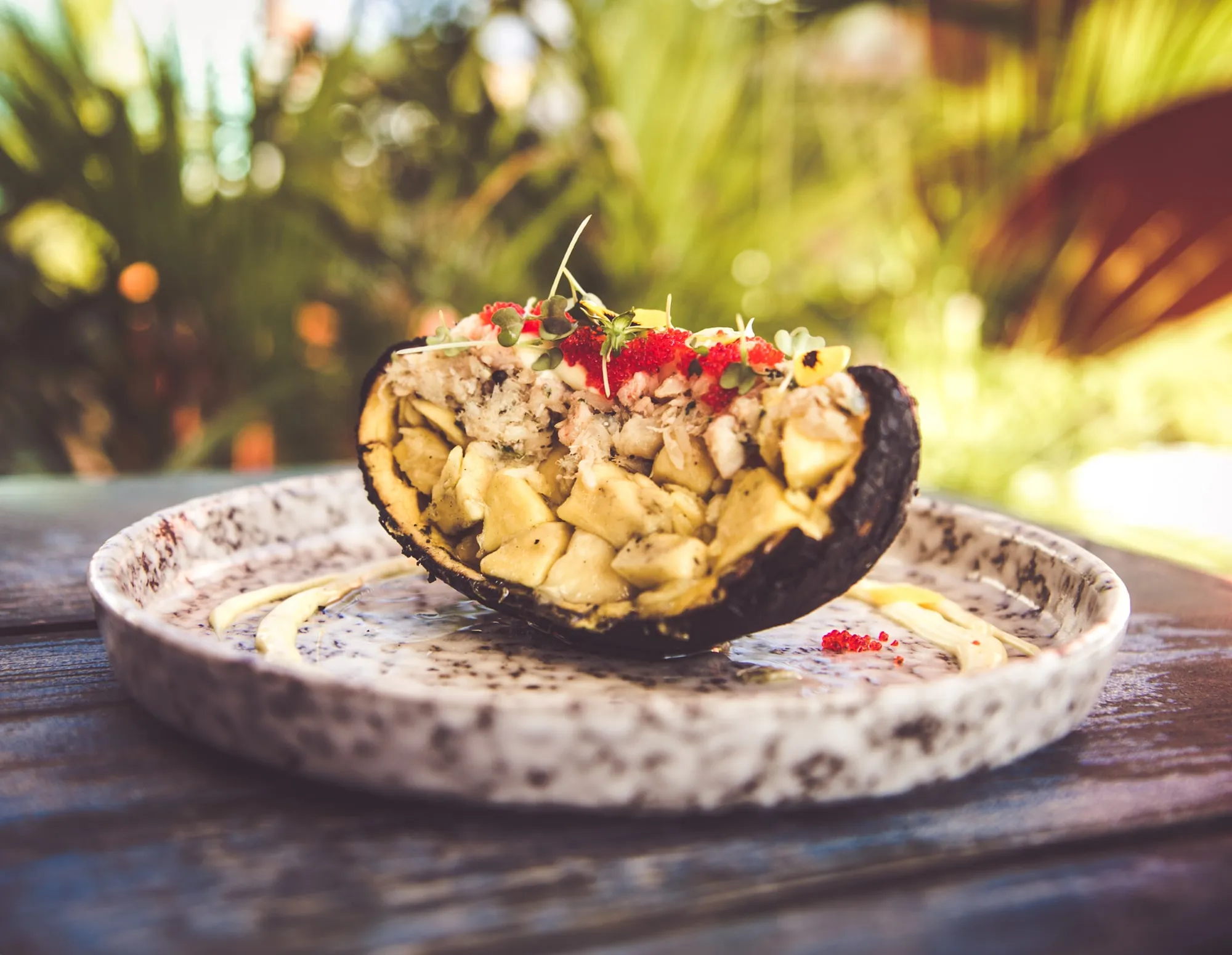
In Barbados, roast breadfruit is particularly associated with local food culture. Its hearty texture makes it a natural accompaniment to seafood and other savoury ingredients, while roasting gives it a distinctive flavour.
Cocktail Kitchen celebrates this ingredient with Roast Breadfruit & Lobster, pairing roasted breadfruit with lobster and other flavours in a contemporary Caribbean dish [2]. It is a good example of how an ingredient with a long history can continue to evolve within modern Bajan cuisine.
Why Is Breadfruit Important to Caribbean Food?
Breadfruit's importance comes from more than its history. It is filling, versatile and able to complement a wide range of savoury ingredients, making it a practical and appealing part of Caribbean cooking.
The fruit also demonstrates how Caribbean cuisine has evolved. Ingredients that arrived from elsewhere have been adapted over generations, becoming part of the food traditions and cultural identity of individual islands.
For visitors to Barbados, trying breadfruit is therefore more than simply tasting another tropical ingredient. It offers a small connection to the history of Caribbean food, while dishes such as Cocktail Kitchen's Roast Breadfruit & Lobster show how that tradition can be interpreted in a contemporary way [2].
If you would like to experience breadfruit in a modern Caribbean dish, contact Cocktail Kitchen to learn more about our menu and dining experience in St. Lawrence Gap.
FAQ
1. Is breadfruit native to Barbados?
No. Breadfruit originated in the Pacific region and was later introduced to the Caribbean [1].
2. When did breadfruit arrive in the Caribbean?
Breadfruit was introduced to the Caribbean during the late 18th century, including through voyages associated with Captain William Bligh [1].
3. How is breadfruit eaten in Barbados?
Breadfruit can be roasted, fried, boiled and prepared in other ways. Roast breadfruit is particularly popular and works well with savoury Caribbean ingredients.
4. Is breadfruit a fruit or a vegetable?
Botanically, breadfruit is a fruit, although it is commonly cooked and eaten more like a starchy vegetable.
5. Can I try breadfruit at Cocktail Kitchen?
Yes. Cocktail Kitchen features Roast Breadfruit & Lobster on its menu, giving the traditional Caribbean ingredient a contemporary treatment [2].
Citations
[1] Artocarpus altilis (Parkinson) Fosberg – General Information, Royal Botanic Gardens, Kew, Accessed October 6, 2026, Kew Science – Plants of the World Online
[2] Cocktail Kitchen | Best Restaurants in Barbados | St. Lawrence Gap Dining, Cocktail Kitchen Barbados, Accessed October 6, 2026, Cocktail Kitchen Barbados
Introduction
Mi tincidunt elit, id quisque ligula ac diam, amet. Vel etiam suspendisse morbi eleifend faucibus eget vestibulum felis. Dictum quis montes, sit sit. Tellus aliquam enim urna, etiam. Mauris posuere vulputate arcu amet, vitae nisi, tellus tincidunt. At feugiat sapien varius id.
Eget quis mi enim, leo lacinia pharetra, semper. Eget in volutpat mollis at volutpat lectus velit, sed auctor. Porttitor fames arcu quis fusce augue enim. Quis at habitant diam at. Suscipit tristique risus, at donec. In turpis vel et quam imperdiet. Ipsum molestie aliquet sodales id est ac volutpat.

Leifend sed nisi. Pulvinar at orci, proin imperdiet commodo consectetur convallis risus. Sed condimentum enim dignissim adipiscing faucibus consequat, urna. Viverra purus et erat auctor aliquam. Risus, volutpat vulputate posuere purus sit congue convallis aliquet. Arcu id augue ut feugiat donec porttitor neque. Mauris, neque ultricies eu vestibulum, bibendum quam lorem id. Dolm posuere ornare leo metus, ultricies. Blandit duis ultricies vulputate morbi feugiat cras placerat elit. Aliquam tellus lorem sed ac. Montes, sed mattis pellentesque suscipit accumsan. Cursus viverra aenean magna risus elementum faucibus molestie pellentesque. Arcu ultricies sed mauris
Leifend sed nisi. Pulvinar at orci, proin imperdiet commodo consectetur convallis risus. Sed condimentum enim dignissim adipiscing faucibus consequat, urna. Viverra purus et erat auctor aliquam. Risus, volutpat vulputate posuere purus sit congue convallis aliquet. Arcu id augue ut feugiat donec porttitor neque. Mauris, neque ultricies eu vestibulum, bibendum quam lorem id. Dolm posuere ornare leo metus, ultricies. Blandit duis ultricies vulputate morbi feugiat cras placerat elit. Aliquam tellus lorem sed ac. Montes, sed mattis pellentesque suscipit accumsan. Cursus viverra aenean magna risus elementum faucibus molestie pellentesque. Arcu ultricies sed mauris